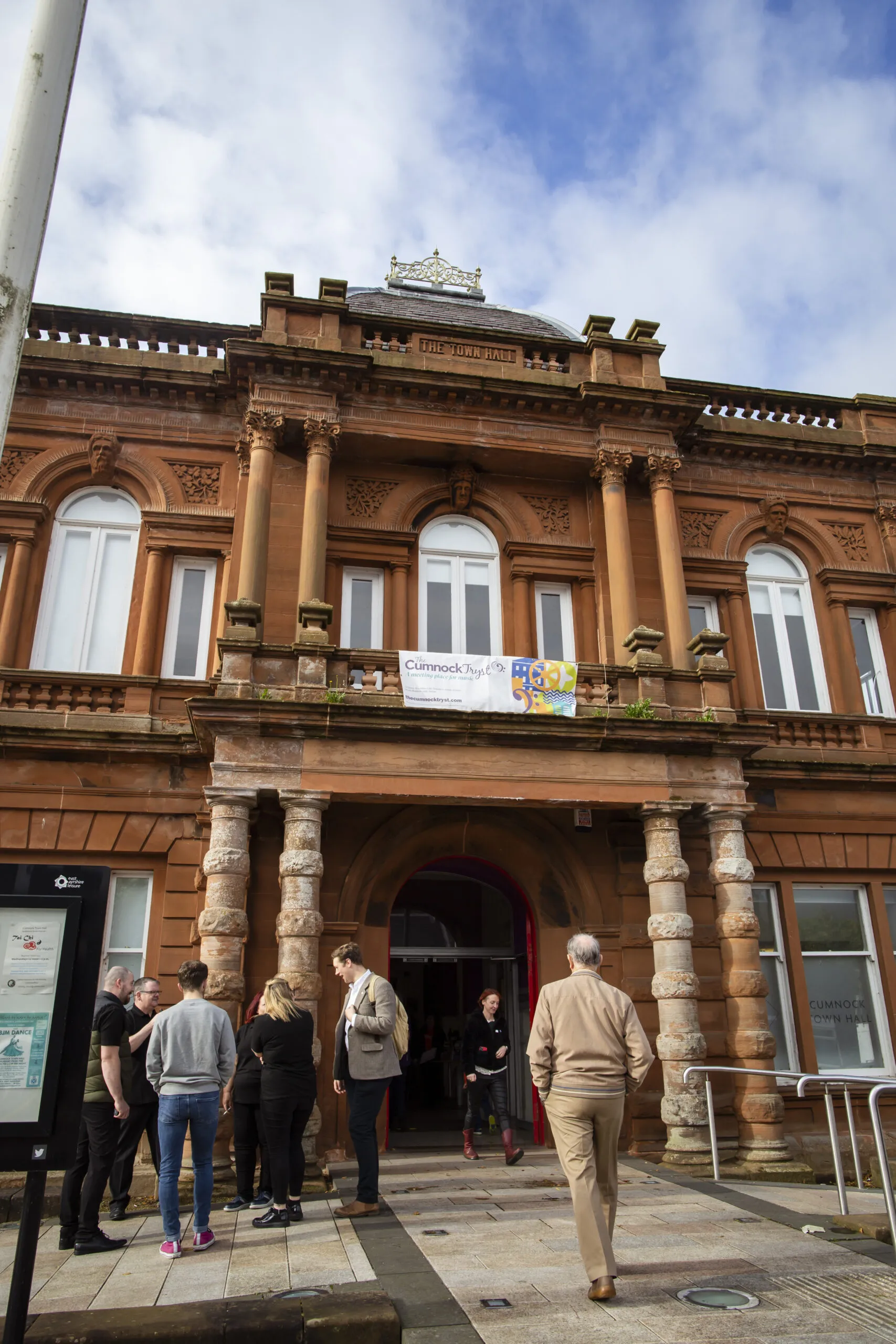
Cumnock Town Hall stands on Glaisnock Street in the centre of the town. Its origins lie in the mining boom of the nineteenth century; after significant population growth linked to the mining industry, the Cumnock and Holmhead area became a police burgh in 1866, and in 1880 the provost, George Samson, launched a campaign to procure a town hall. The project was helped considerably by the local landowner: John Crichton-Stuart, 3rd Marquess of Bute, donated the site and contributed £500 towards construction.
Designed by Robert Samson Ingram in the Renaissance Revival style, the hall was built in red ashlar stone from the Ballochmyle Quarry at a cost of £3,000 and officially opened by the Marquess of Bute on 6 June 1885. That distinctive reddish sandstone recurs throughout Cumnock’s Victorian architecture.
For much of the twentieth century the building served a dual civic and cultural role. It housed the burgh council until the enlarged Cumnock and Doon Valley District Council was formed at Lugar in 1975, after which it continued as a community events venue hosting concerts and theatre performances.
Today the hall is a Category C-listed building (listed in 1977). It has undergone extensive restoration using traditional materials while incorporating updated facilities, and now operates as an arts and entertainment venue for shows, music and comedy, while remaining available to hire for weddings, parties and community groups.
Two monuments stand outside. A bust honours James Keir Hardie, who worked as a journalist in Cumnock and founded the Scottish Labour Party in 1888, reflecting that the father of Scottish socialism lived most of his life in the town. More recently, a floral tribute encircled in steel, commemorating the Platinum Jubilee of Elizabeth II, was unveiled in May 2022
2026 festival
What’s on
Come and join us for the twelfth festival edition of The Cumnock Tryst. It’s not to be missed this year. But we say that every year!